THE OTHERS
A Work-in-Progress
All information on this page is confidential.
Please, DO NOT share this link, or its content, with others.
What is THE OTHERS?
An immersive installation/responsive environment examining the power of language in a world where dehumanising and othering is an increasingly prevalent rhetoric.
Future exhibition confirmed at Haarlem Gallery, Wirksworth, in 2027 (date TBC)
Other exhibition venues are anticipated (TBC)
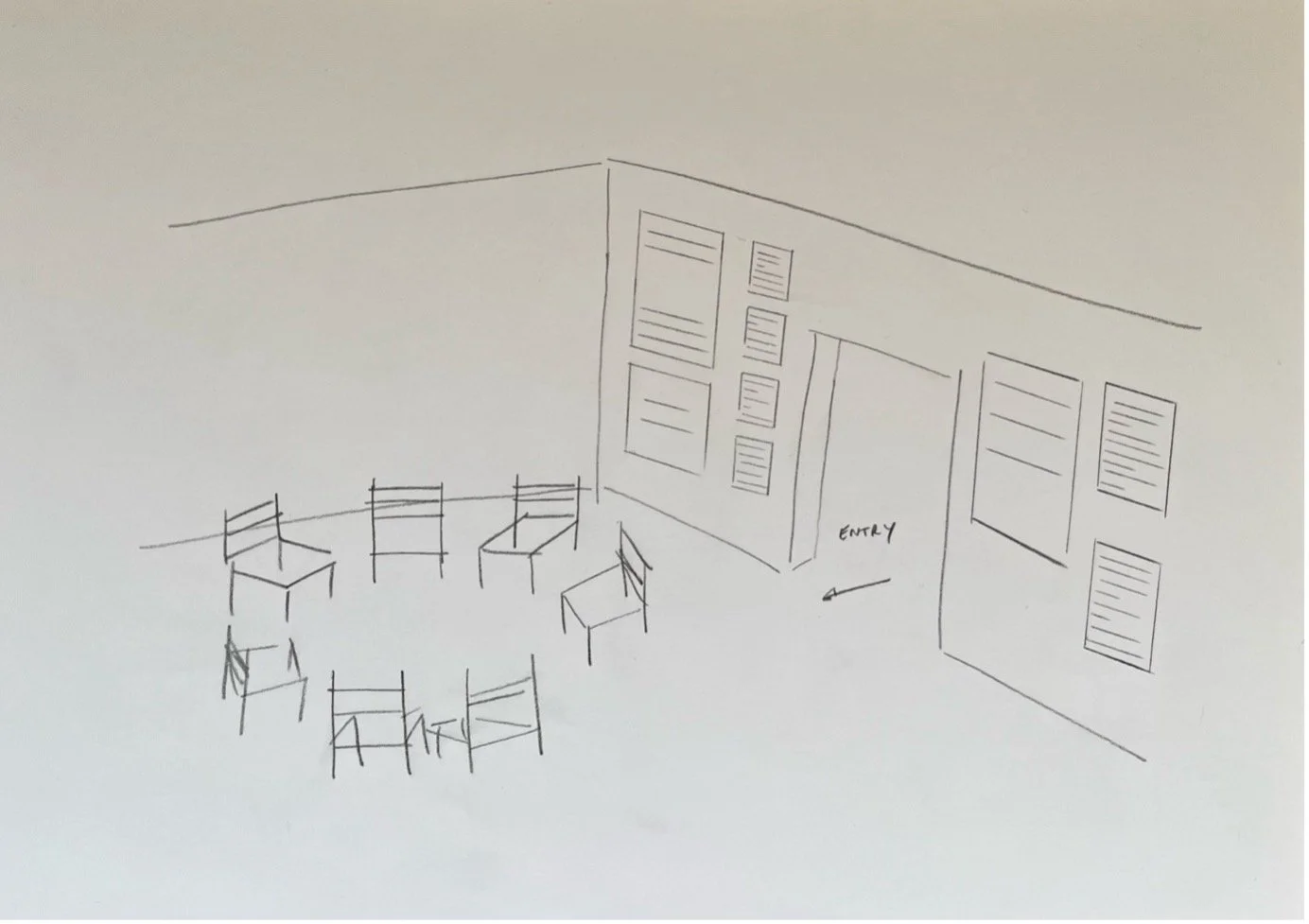
A circle of chairs sits in the centre of room. Instructions, schematics and technical specifications of the inner working of the installation adorn the walls; printed texts listing every audio phrase the work contains, texts about dehumanisation and ‘othering’ (McEvilley et al.), the full tech rider, coding and so on. Here, there is full transparency.
A women’s voice relates events as they unfold within the gallery.
Appropriating dehumanising language of immigration agents, politicians, and news outlets, audience members will be referred to simply as ‘bodies’.
“Two more bodies have entered the room. They have joined the inner circle. The group is growing in number and in confidence. Together, they have more political power to demand change.”
The narration will touch on Foucault’s ‘biopolitics’ and Greek and Roman philosophy of the body politic, considering ideas of collectivism, community and power.
When ‘bodies’ gravitate towards the circle of chairs, the narration will be light, positive, and full of hope. When they linger in the open, disassociating themselves from the group, the narration will focus on division, dehumanising, and ‘othering’.
Audiences will develop a strong feeling of presence - of being inside the experience, bearing witness, and having an effect upon how it develops. All they have to do is be there.
The installation reimagines the algorithms shaping contemporary political systems as a potential site for kinship, community building, refuge, care, and empowerment. A place to shape an inclusive environment, where shared values are held in common, as a remedy against current attempts of division and othering.
Audiences’ movements will be tracked using CCTV and subject detection technology, measuring only the number of bodies in the room and their location. Audience movements and positions will be used to trigger a large database of audio narration excerpts observing community strength (based on numbers) and speculating on individual’s intentions. This installation will not monitor age, gender, race, etc, simply the presence of indeterminate physical bodies. Reducing audiences to ‘bodies’ highlights dehumanisation techniques currently used in the media, political rhetoric and warfare, whilst remaining basic enough to speak of the human condition. It also highlights the power of bodies of people as collective groups. There is strength in numbers.
This project draws primarily upon two previous works:
Narrating the Barbican (2013) combined audio narration, immersive theatre and relational aesthetics in a promenade performance that moved throughout the public spaces of the Barbican, London. Following 'a women in a blue dress and half worn-out shoes', her engagement with the Barbican was narrated via the public address system, as though she were being observed live.
https://www.alisonballard.com/narrating-the-barbican
The Narrator Is Present (2017) asked, how can we distinguish fictional narrative from truth among the multitude of disembodied voices on the Internet? As visitors entered the gallery, actors narrated their actions live, drifting between documentary and fiction - sometimes playful, sometimes troublingly divisive. The piece existed simultaneously in the gallery and online, exploring dualistic experiences of the virtual and physical. Although successful, a lack of funding meant it was poorly equipped and the internet connection slow, creating a delay between audience movements in the gallery and the narrator’s voice.
https://www.alisonballard.com/the-narrator-is-present
Alongside my Practice, I am a Professional British Voice Over, with a home studio offering broadcast-quality recording, production, and editing. I will use these facilities to record and edit the audio narration in The Others.
https://www.alisonballardvoiceover.com/
Alternatively, I am considering using AI-generated narration, in-line with the technological messaging of the work - that all technology used in this work is easily accessible to anyone (see below).
The Technology
The installation will use commercially available equipment (e.g. Amazon / free open source programmes online), to highlight how accessible these are - these are not just tools for governments and large corporations; they are accessible to us all. We can use them to divide, or we can use them to empower.
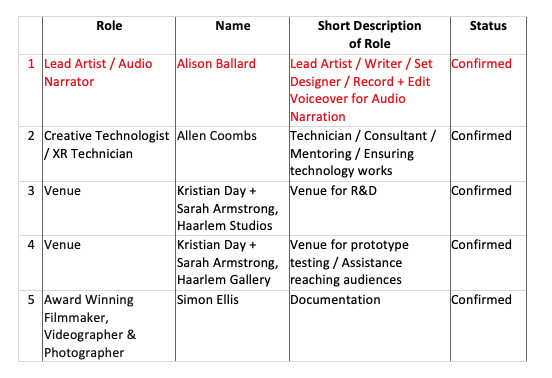
I will collaborate with Creative Technologist Allen Coombs for the first time. He will help me realise my ambitions, teaching me and advising on hardware, software, and coding, and support installation in the gallery. He has all the abilities I don’t (yet).
Power over Ethernet (PoE) cameras negate the need for internet (removing dependency on venues), making the installation more sustainable and available to a broader range of venues to exhibit in future.
When + Where
The installation will be tested with a public audience and invited guests at Haarlem Gallery, Wirksworth, Derbyshire, UK (Confirmed Project Partners).
Wirksworth has a diverse population who identify as transgender, genderqueer, disabled, neurodivergent, from the global majority and from vast economic backgrounds. Staging tests here will reach diverse audiences for valuable feedback on the effectiveness of the experience alongside whether more can be done to improve access and inclusion. Unfortunately, Haarlem Gallery is not wheelchair accessible, therefore, I am seeking future partnerships with fully accessible gallery spaces and galleries with accessibility programmes.
Why This? Why Now?
This project will enable me to take an ambitious step forward to professionalize my practice through the use of new immersive technologies and associated skills.
I will work with Allen Coombs for the first time, learning new skills in motion tracking and coding for responsive environments, and using several technologies for the first time (inc. PoE cameras, routers, OpenCV).
With this investment, my practice will become self-sustaining, equipping me with the skills, knowledge, and equipment I need to pursue more immersive artworks in future. I will be able to create new artworks and exhibit more, with new skillsets to bring to future projects and collaborations.
Through this change in practice, I aim to make the current landscape in immersive arts more accessible for those who identify as disabled, immunocompromised and/or neurodivergent.
Who else is Involved in THE OTHERS?
Access, Diversity, and Inclusion
I will adopt a social model of disability, following guidance from Unlimited, Disability Arts Online, Shape Arts, and drawing on my personal experience of living with Multiple Sclerosis.
I will use neurodivergent-informed, user-centred design, avoiding overly busy visuals.
‘Quiet’ times - when audiences wear headphones, will allow personalised volume control and a more intimate experience with binaural audio.
Wirksworth has a diverse population who identify as transgender, genderqueer, disabled, neurodivergent, from the global majority and from vast economic backgrounds. Staging tests here will reach diverse audiences for valuable feedback on access and inclusion.
Installation elements will be generously spaced, allowing social distancing for immunocompromised and neurodivergent audiences.
I am keen to hear from other artists/galleries/organisations/professionals about other ways I can improve access and inclusion - If you can help, please, get in touch.
Evaluation
Audiences will be observed, to learn how they move throughout the space, how long they spend interacting, what their engagement looks like, and whether they return.
Audiences will be surveyed, to find out whether they do, indeed, find the experience immersive, whether it feels inclusive to them, and whether themes within the work are successfully conveyed. I will gather thoughts on onboarding, accessibility and inclusion, and invite suggestions for ways future iterations might be improved.
In addition, a small group of curators, artists, and audience members, will be invited to evaluate the artwork more deeply during a feedback session following the showcase. I will draw on their diverse range of skills, experiences, and viewpoints to gain insights to use in future development.